Product Categories
SEARCH WHAT YOU WANT

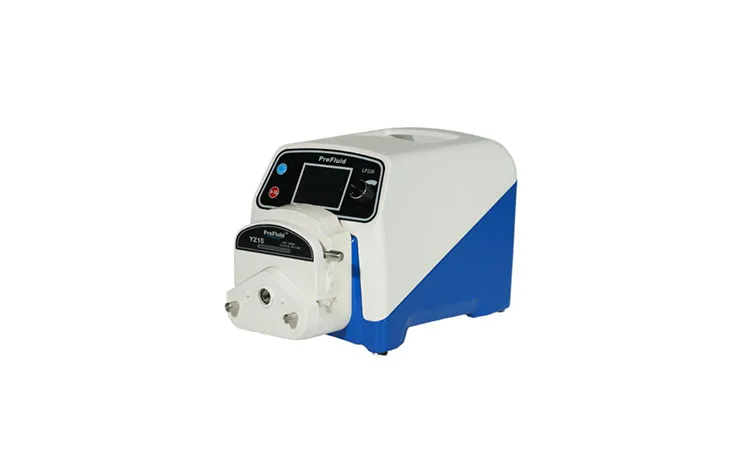
Converting between a peristaltic pump's rotational speed (RPM) and flow rate (ml/min) requires considering factors such as the tubing's inner diameter, the pump head model, and the flow coefficient. The specific methods are as follows:
I. Basic Formula Method
The general calculation formula is:
Q = (π · D² / 4) × N × K
Q: Flow rate (ml/min)
D: Tubing inner diameter (mm)
N: Rotational speed (RPM)
K: Flow coefficient (typically between 0.5 and 1; specific values should be referenced from the equipment parameters)
Example: If the tubing inner diameter is 5 mm, the rotational speed is 100 RPM, and the flow coefficient is 0.8, then the flow rate is:
Q = (3.14 × 5² / 4) × 100 × 0.8 ≈ 1570 ml/min
II. Flow Curve Method
Conversion using the pump head-tubing flow rate curve chart:
Determine the Tubing Model: Based on the target flow rate and the pump head model, select the tubing that meets the specific requirements.
Example: For an LP120-YZ15 pump head (maximum speed: 300 RPM) requiring a flow rate of 300 ml/min: Tubing #25 has a flow rate of 960 ml/min at 600 RPM; by proportional conversion, its flow rate at 300 RPM is 480 ml/min, which satisfies the requirement.
Calculate Rotational Speed: If the desired flow rate and tubing parameters are known, calculate the required rotational speed using the proportional formula.Example: If a #25 hose delivers a flow rate of 960 ml/min at 600 RPM, the required rotational speed to achieve a target flow rate of 300 ml/min is:
(300 / 960) × 600 ≈ 187.5 RPM
III. Displacement Per Revolution Method
For certain equipment, the following formula can be applied directly:
Q = V × N
V: Displacement per revolution (ml/r)—please refer to the equipment manual.
Example: If the displacement per revolution is 5 ml/r and the rotational speed is 100 RPM, the resulting flow rate is 500 ml/min.
Important Notes
Actual flow rates are influenced by factors such as liquid viscosity, pressure, and ambient temperature; therefore, it is recommended to calibrate the equipment before use.
Flow rate curves vary significantly across different pump head models (e.g., YZ15, KZ15); please consult the specific model specifications for accurate data.
Converting between a peristaltic pump's rotational speed (RPM) and flow rate (ml/min) requires considering factors such as the tubing's inner diameter, the pump head model, and the flow coefficient. The specific methods are as follows:
I. Basic Formula Method
The general calculation formula is:
Q = (π · D² / 4) × N × K
Q: Flow rate (ml/min)
D: Tubing inner diameter (mm)
N: Rotational speed (RPM)
K: Flow coefficient (typically between 0.5 and 1; specific values should be referenced from the equipment parameters)
Example: If the tubing inner diameter is 5 mm, the rotational speed is 100 RPM, and the flow coefficient is 0.8, then the flow rate is:
Q = (3.14 × 5² / 4) × 100 × 0.8 ≈ 1570 ml/min
II. Flow Curve Method
Conversion using the pump head-tubing flow rate curve chart:
Determine the Tubing Model: Based on the target flow rate and the pump head model, select the tubing that meets the specific requirements.
Example: For an LP120-YZ15 pump head (maximum speed: 300 RPM) requiring a flow rate of 300 ml/min: Tubing #25 has a flow rate of 960 ml/min at 600 RPM; by proportional conversion, its flow rate at 300 RPM is 480 ml/min, which satisfies the requirement.
Calculate Rotational Speed: If the desired flow rate and tubing parameters are known, calculate the required rotational speed using the proportional formula.Example: If a #25 hose delivers a flow rate of 960 ml/min at 600 RPM, the required rotational speed to achieve a target flow rate of 300 ml/min is:
(300 / 960) × 600 ≈ 187.5 RPM
III. Displacement Per Revolution Method
For certain equipment, the following formula can be applied directly:
Q = V × N
V: Displacement per revolution (ml/r)—please refer to the equipment manual.
Example: If the displacement per revolution is 5 ml/r and the rotational speed is 100 RPM, the resulting flow rate is 500 ml/min.
Important Notes
Actual flow rates are influenced by factors such as liquid viscosity, pressure, and ambient temperature; therefore, it is recommended to calibrate the equipment before use.
Flow rate curves vary significantly across different pump head models (e.g., YZ15, KZ15); please consult the specific model specifications for accurate data.